
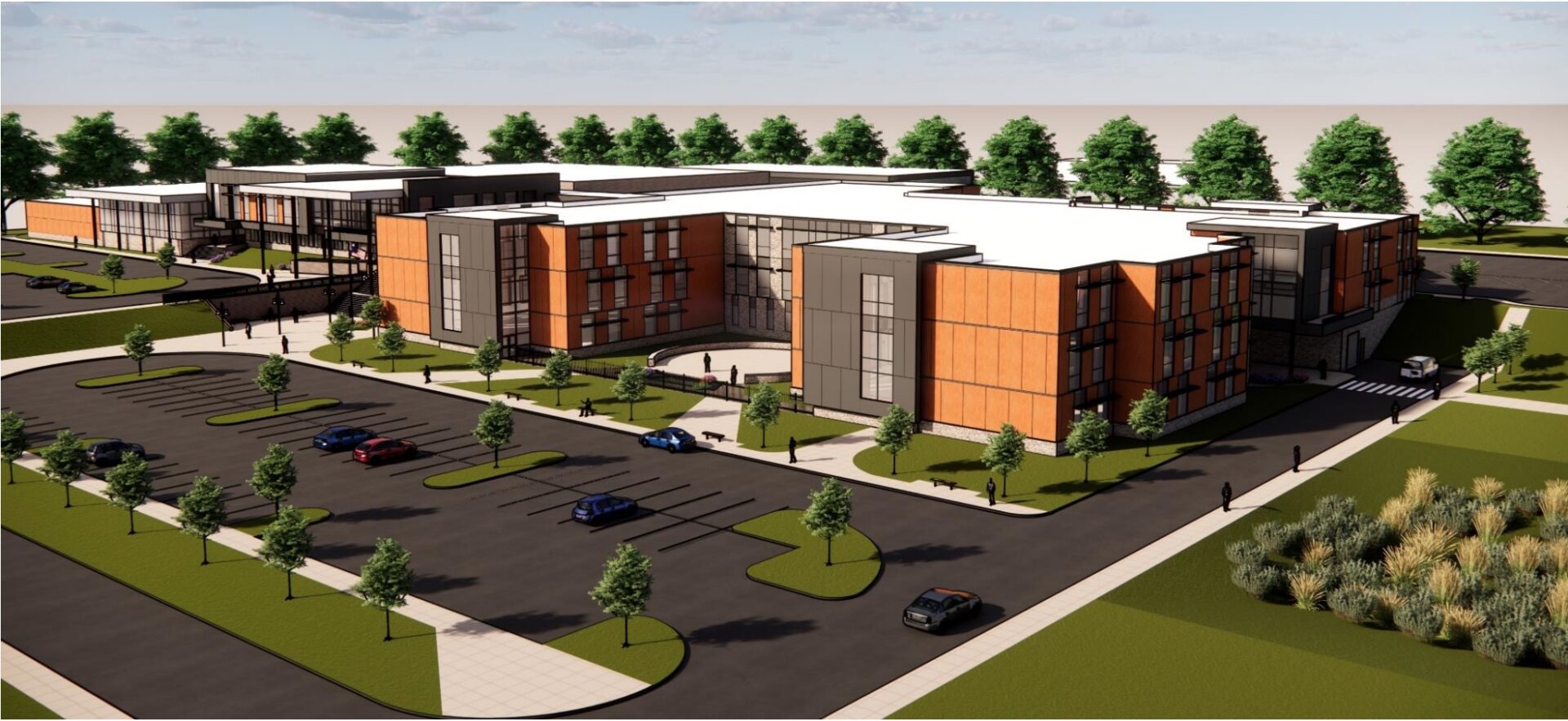
Bids for construction of State College Area School District’s new Park Forest Middle School came in well below estimates, according to a presentation to the school board on Monday night.
Apparent low bids for seven prime contracts totaled $112.2 million, about $18.1 million, or 14%, less than the projected $130.3 million. That encompasses base bids and seven alternates for construction of the 270,000-square-foot school to be located off of Valley Vista Drive, across from the current Park Forest Middle.
Bids were about $12.5 million, or just under 10% below estimates, and were further reduced by allowing contractors to submit an alternate site wall design that saved another $4.5 million, along with additional savings from recommended alternates.
“Although bids came in favorably and construction costs are lower than anticipated, the district continues to face significant capital needs in the years ahead,” finance and business officer Randy Brown and physical plant director Mike Fisher wrote in a memo to the board. “These savings will help reduce the overall financial strain as we plan for and address those future projects.”
In total, the project is now expected to cost $137.4 million, including construction, design, financing, furniture, fixtures and equipment, other soft costs and road improvements on Valley Vista Drive — nearly 10% less than the estimate of $152 million,
“We may not spend all these dollars but we’re trying to set the overall budget and think of every occurrence so we’re setting a maximum budget,” Jeff Straub, of project architect Crabtree, Rohrbaugh and Associates, said.
Lobar Inc. of Dillsburg — which worked on the new State College Area High School and three elementary school projects — was the apparent low bidder for general contractor at $55,547,000. Other low bidders were site contractor Glenn O. Hawbaker, HVAC contractor Midline Mechanical, plumbing contractor Silvertip, electrical contractor Westmoreland Electric, fire protection contractor S.A. Comunale and food services contractor 11400 LLC.
The project received strong interest with three to six bids per prime contract, which Straub said helped to bring it “substantially under budget.”
CRA and district administratrs recommended addition of alternates including a 2,000-square-foot storage area, increasing the roof warranty from 20 to 30 years, a roof stair, snow-melt system, a a 688 kW rooftp solar array, additional generator capacity beyond life safety and lighting required in the base bids and contractor responsibility for any underground rock encountered during construction.
Among the alternates not recommended were bird-friendly glass either at the stair towers, or the two entrances, library, gymnasium and cafeteria. Those alternates ranged from $99,000 to $102,000.
Brown said the district is currently working with community groups on alternates to bird-friendly glass at Spring Creek Elementary School that have been utilized at Penn State and would be “much more cost-effective.” Fisher explained the most likely option would be small round stickers that “blend in” but can be seen by birds.
“We expect that after that test case is worked out then we would begin implementing throughout the rest of the district,” Brown said.
Board member Amy Bader said that was “a little vague in terms of what that looks like aesthetically,” and that she had concerns about how it would scale to the much larger window expanses at Park Forest.
“I have some concerns about the logistics of managing that over the long term versus investing in a glass… I’m not discounting, $100,000 is $100,000, but we also spent 70K because we wanted to retain the stone facades at the high school for aesthetic reasons,” Bader said. “I just personally would need some more information before I felt that I could make a decision on that.”
After other board members raised the issue and Superintendent Curtis Johnson noted that the district previously received extensive public comment advocating for bird-friendly glass, Brown said the administration will move forward with the assumption. of adding the alternate for the common areas, as well as providing the board with as much information as possible about the options being tested at Spring Creek.
Brown also explained that he did recommend the $515,000 alternate for the snow-melt system — a hydronic loop pipe system under concrete walkways, stairs and ramps — both to reduce staff time spent clearing those areas and prepare the facility quicker for other staff. He also said the district had an increase in slips-and-falls amid an icy winter this year.
“There was no apparent area where we should have done something different … but we did have an increase in worker’s comp for slips-and-falls, so I think that’s a good investment over time even though it is a large amount of money,” Brown said.
What’s Next
The school board will vote on approving bids at a future meeting.
Construction is expected to begin in May and be substantially completed in November 2028 for a January 2029 opening. SCASD has not yet determined what it will do with the current Park Forest Middle School when the new building opens.
The new three-story building will replace the existing, 54-year-old Park Forest Middle School, which was last renovated in 1995 and had long been eyed by the district for major reconstruction or replacement.
Plans include a main entrance that will lead to a public lobby and what Straub previously called a “main street” accessing the main gymnasium, auditorium, music space and cafeteria. A second-floor media center will have a centralized location overlooking the main street with views out onto the campus and surrounding park.
The layout will allow for after-hours use with the ability to lock down the classroom wing, which will be stacked for students to move upward through sixth, seventh and eighth grades. A “student street” design will also include science commons, art and languages spaces and more.
“The district’s been talking about Park Forest for 20-plus years. I know when we were doing the high school we were talking about Park Forest as something that needed to be dealt with in the future,” Straub said on Monday. “I’m very happy we could bring the project in under budget, not just all those years but then the last two years of planning and all the meetings we had with you and the community. So it’s great as we can transition from design to construction that we’re able to bring the project in under budget for all of you. These are much easier discussions now of whether an alternate is or is not part of the project when the entire project is substantially under budget.”



